Thursday, October 27, 2011

Important 18th Century French Chairs at New York City's Premier Dealer Dalva Brothers


Any serious collector or connoisseur of 18th Century French furniture has made the mandatory pilgrimage to the legendary family owned antiquaire, Dalva Brothers in New York City. Situated after a recent relocation in a historic town house at 53 East 77th Street, this gallery of Olympian category has various floors of boiserie paneled rooms offering a dazzling selection of cabinet work as well as the art of menuiserie on which we shall focus in this visit. Menuiserie was the art of the wood carver who specialized in chairs and other seating, console table and frames of various sorts. The strict guild regulations clearly separated the menuiseur from the ebeniste who specialized in case furniture that was veneered. During my recent visit with Mr. Leon Dalva, the current owner, I was given the customary cordial greeting by this gentleman whose erudition is matched by his affability and delight in sharing his enthusiasm with collectors and historians of the period whose seriousness is evident. I had the pleasure of first meeting this exceptional gentleman in 2007 when I directed a workshop for appraisers in NYC about French 18th Century furniture and on which I collaborated with the world recognized expert in the field, Mr Thierry Millerand. Thierry kindly arranged an excursion to Dalva Brothers to be a perfect ending to this two-day workshop which allowed the participants a chance to view this exceptional museum quality collection in the company of these 2 widely acknowledged authorities. It was quite a thrill! And for me it was a most gratifying introduction to Leon Dalva and his lovely wife Nancy who was also present. During a more recent visit, I discussed several of the gallery inventory's chairs with Leon Dalva who balked with utter conviction at my observation about what I perceive as a waning taste for great French furniture of the Ancien Regime in the collecting and auction world of the early 21st Century. To such a suggestion he replied without a moment's hesitation, "French 18th Century furniture is alive and well here at Dalva!" When you visit, it's easy to agree with him and to question how anyone would not want to collect such glorious furniture if given the opportunity.

Leon Dalva's enthusiasm is unabashedly contagious! And no wonder... The inventory in the settings of finely carved wall panels and creaky wood floors is utterly mesmerizing in its beauty!

Take for instance this chair which is part of a suite attributed to the greatest menuiseur of the reign of Louis XVI, Georges Jacob. The set was executed on the eve of the Revolution in an assertively avant guard style anticipating the Empire under Napoleon with its reliance on Egyptian motifs.


In a more familiar manner is this perfectly carved and oil gilded Louis XVI pair of fauteuils of which we see an example. Oil gilding was a less commonly used technique (as opposed to the more common technique of water gilding) and surviving examples of chairs with the original oil gilding are very rare.


Below is a fine example of the late Louis XVI's period penchant for "Anglomanie" in certain court and aristocratic circles with favoured the use of mahogany in both cabinet work and seating. This particular armchair was clearly designed for an officer to whom it was important to be able to seat himself comfortably while wearing his understandably cumbersome sword! Note the exaggerated inward curvature of the support on the arm and you can see how the client often worked with the artisan to ensure a successful design that was also accommodating the patron's needs while resulting in what had to be the most harmonious period of successful collaboration between patron and artisan in Western history!


Of course Dalva Brothers has much more than just the chaste neoclassicism of the Louis XVI period in its vast and uniformly superb inventory. The Louis XIV period is well represented with such examples as this assertive fauteuil of the 17th Century with what appears to also be original gilded wood.


Plenty of exceptionally fine Louis XV chairs are part of the Dalva Brothers collection. Most outstanding to my mind was this pair of fauteuils of which we have an example below in which a truly rare and not often seen finesse of carving is immediately apparent with the rhythmic and twisting vines and foliage carved by the hands of an obvious virtuoso! In this instance the menuiseur was one of the period's greatest artisans L. Cresson who was well patronized in court circles.


Other examples seen below are ample testimony, in visual and tactile terms, to Talleyrand's often cited remark that only those fortunate enough to have enjoyed the world of elite Parisian and court society before 1789, could understand how sweet life could be for that enviable and enticing ruling caste!


Wednesday, April 6, 2011

An 18th Century Folie, First in a Series: Le Pavillon de Musique de Madame Du Barry


From all accounts Madame Du Barry had everything it took to become a siren and sex symbol of the same level as Liz Taylor. Even people predisposed to disapprove of her on the basis of her early career as a deluxe call girl and later as the last official mistress to the aging Louis XV during his twilight years, had to admit, after meeting her and enjoying a conversation, that she was charming, likable, egalitarian in her good manners and kindness. Blond bombshell that she was... She was no fool. It certainly didn't hurt that she was stunning. Had she lived today, with her natural physical beauty, her easy manner, and her geisha-like desire to make the person with whom she was speaking at a given moment feel like the centre of her universe, she'd still be a celebrity. No question!


Of course, the apogee of her "career" started in 1769 when she was introduced to Louis XV, seen below in the portrait by Drouais, by one of her "clients" the aging rakish and utterly mesmerizing (if no less utterly cynical) Duc de Richelieu. Richelieu was one of the king's closest friends. What even Richelieu did not expect, as did no one else, was that Louis XV liked her so much in bed he broke all traditions and court customs and installed her at court in her own apartments and shortly after that arranged to bend the rules and made her is official mistress.


This was unimaginable! Not that the king would have an official mistress... That was expected. What totally nonplussed even the most worldly courtier what that the position was not filled by a married woman born into a higher rank in society - and customarily from the court itself. At the same time, to quell criticism a bit, and to cover his bases, Louis XV arranged for her to marry the country bumpkin elder brother of her utterly handsome well born and rather ambitious pimp who happened to be a minor noble too poor to live at court and who was living in the provinces in a crumbling chateau. The groom was the Comte Du Barry. A Count! How convenient! Instant pedigree by marriage! He immediately came to court at Royal command solely for the wedding. He was promptly sent back home to the provinces and never saw the bride again. Mission accomplished. One of the Paris's most celebrated and expensive prostitutes was now the king's favourite and was to go by the name of La Comtesse Du Barry!


With the position came the perks. And a little real estate was one of the most important rewards for any official mistress of the king of France. A mistress of the king could enjoy the use of such a gift during her entire lifetime - even if the king should predecease her. Not a bad fringe benefit!

In truth, the only large country house she was given was a modest - if charming chateau I recently spotted at the village of Louveciennes just a 15 minute drive from Versailles. It is seen below.


The main chateau is not the reason to visit. Though old monochrome photos suggest it's lovely inside with finely carved boiseries... However, it's now apparently privately owned and not easily accessible. The reason to visit is to see the one addition of a separate pavilion for entertaining that Madame Du Barry commissioned in the early 1770's from one of the most avant garde and sophisticated architects of the day, Claude Nicholas Ledoux. Ledoux's Palladian influenced classical style is still appealing to modernists and has a very clean contemporary demeanor that is still reverently rooted in Classical traditions. He was hugely admired by Thomas Jefferson. This is his portrait displayed at the Pavillon de Musique today...


At the Pavillion de Louveciennes he created one of the most fetching folies imaginable for entertaining.


I was charmed approaching the entrance vestibule, as must have been 18th Century guests of Madame Du Barry, as I made my long overdue visit for the first time...


Below is the lesser seen rear facade of the Pavillon de Musique de Madame Du Barry...


Alas! The house as seen today has been relocated a few meters, has had an additional attic story added in the 1920's by a prior owner and understandably attracts the derision of purists who say it's not worth even visiting. I disagree. Granted, it's suffered alterations. But enough is there to get a feeling for how the house seemed in the 1770's when Madame Du Barry entertained Louis XV there one evening in the large central vestibule hall also known as the Salle de Musique. One thing is certain. This was the retreat of a very well kept woman... And happily for us, she had unfailing good taste!


The dinner Madame Du Barry held for Louis XV was happily recorded in this lovely watercolour by Moreau le Jeune and seen below. The same room is very recognizable.


Another unforgettable detail still in place is the collection of utterly jewel-like and finely chased ormolu door and window hardware. Such details, along with the furniture which was once there and which was long ago dispersed into museums and private collections, were noted in the memoirs of one special visitor, the portrait painter Madame Vigée Lebrun.


Among the items once adorning the Pavillon de Musique was a pair of seductive torchères by Pajou which are now displayed in New York's Metropolitan Museum of Art. This is one of them...


And of course, it was for this ravishing folie that Fragonard had originally created his series of canvases on "The Pursuit of Love" which Madame Du Barry rejected in favour of inferior but appropriately more vigorously Neoclassical paintings by Vien. Admittedly, the Vien paintings series is not as sublime as the Fragonard series. But the paintings she decided to install here were very `a la mode for the time and more in keeping with the classical mood of the decorative ensembles.
Two examples of the paintings she opted to mount on the walls of the pavilion are seen below. They are currently in the Louvre in Paris.


The paintings were originally mounted on the walls of what was oddly termed the "Salle de Cul".  Below is a view of how that room appears today. It is just off the Salle du Roi which is the central drawing room. 


Ironically, copies of the Fragonard paintings (of which the originals are now in New York's Frick Collection) have been placed in the dining room at the pavilion where they are currently on view. It's also interesting to note that, though the canvases were originally commissioned for this building, they would have not been placed in this room which is on the opposite side of the Salle du Roi. As just noted these were intended to be installed in the room we've just visited above.


Other adjacent rooms, though unfurnished, are still lovely to behold! This is the central Salle du Roi to which I alluded earlier.


It is in the centre just off the large Salle de Musique where Madame Du Barry entertained Louis XV and other guests as seen in the Moreau le Jeune drawing we saw above. The Salle de Musique is discernible from here through the doors.


Interestingly, it was in this drawing room that a recent photo shoot was done for the 2009 Dieux du Stade calender of studly French rugby players! What would Madame Du Barry have made of that?


 This is Madame Du Barry painted by Vigée Lebrun in 1783 after her "retirement" from court... The portrait is currently in the collection of the Corcoran Museum in Washington, D.C.


Perhaps, being the friendly gregarious lady she was, Madame Du Barry would be amused to learn that today the Pavillon de Musique de La Comtesse Du Barry is owned and operated by the Fondation Julienne Dumeste. It is available for rental for weddings, conventions and other special events and can also be visited by appointment.


Monday, October 11, 2010

Furniture Discussion, 2nd in a Series: Les Chaises Voyeuses in 18th Century France

The voyeuse is an often misidentified form of seating furniture produced in France in the 18th Century. It is often mistaken for a prie dieu chair which is, as implied by its name, for devotional practices and used by gentlemen and ladies for kneeling upon while saying morning or evening prayers. The prie dieu is emphatically lower and it's obvious no one of normal scale or stature and sit on it as it's clearly exclusively for kneeling. I good example of a prie dieu is seen below in this photo I took of one fine example in the Musée Lambinet in Versailles last month.


The voyeuse is for a clearly more mundane purpose! It was a chair on which a gentleman or lady would, in fact kneel casually while taking in a card game in which he or she was not directly actively taking part as a player. The chair was usually positioned with its back facing towards the players and the gaming table in the periphery of the gaming activity. One thing should be made clear here as it's often believed incorrectly to be the case. A voyeuse was not occupied by the card players at the table with the spectator leaning over the player on the padded chair rail which is the principal feature that distinguishes the voyeuse from an ordinary side chair or dining chair. Below in the photo I took at Versailles this past month, you can see a good example of a standard voyeuse chair by Claude Sené in Louis XVI's private dining room in the royal chateau in his Petits Apartments. As in most examples it has an upholstered back surmounted by the required padded chair rail on which the occupant rests his or her forearms.


Many voyeuses are scarcely distinguishable from a side chair in either the Louis XV or Louis XVI periods. However it's obvious this seating form reached it's apogee of beauty under the later reign when it was often characterized by superb and delicate carved decoration on an open back with a lyre motif! Not surprisingly, Georges Jacob and some of his contemporaries like Henri Jacob or Martin Jullien made a specialty of such voyeuses with a lyre motif on the back.

A fine example is seen here. It was offered at Christie's Paris in December of 2007 as lot 92 in the sensational auction of the excess inventory of the legendary Parisian antiquaire Bernard and Benjamin Steinitz. This example is stamped by Jullien. We can only hope the winner of this charming voyeuse at this stellar auction has taken great care to show it the respect it deserves and has upholstered it in something lovely, appropriate and stunning by the likes of Scalamandré!

A Visit to The Lambinet Museum in Versailles


A Few great cities and smaller ones have a museum dedicated to exhibiting art and historical artifacts that essentially are put to the task of telling the history of the city and its cultural contributions. Perhaps the most notable is the Carnavalet in Paris. However less known, and only a short drive or train ride away is the Musée Lambinet which is dedicated to the City of Versailles and which has just been unveiled after having had a major renovation that was definitely worth the wait!


When I attended on the reopening day in September, it coincided with that massively attended weekend of Patrimonie Nationale during which anyone can, for no admission fee, enter museums and historic houses (including some like government ministries not usually accessible to the public) The crowds were predictably considerable and daunting. But it was also encouraging as it showed just how much the local Versailles community love their museum which is virtually unknown in the USA - even among the most committed lovers of the 18th French Century.


The Musée Lambinet is a municipal museum in Versailles telling the history of the town. Since 1932 it has been housed in the Hôtel Lambinet, a hôtel particulier designed by Élie Blanchard, built in the second half of the 18th century by a part of the Clagny Lake (drained during the reign of Louis XV to encourage the city's expansion and development) and left to the town of Versailles by the heirs of Victor Lambinet (a cousin of the painter Émile Lambinet) in 1929. It has been classed as a monument historique since 1944. Its garden façade has a sculpted pediment representing an allegorical figure of architecture.


The museum has 35 rooms, some with period decor. One one floor is a very charming recreation of a gentleman's domestic establishment with the table laid out for dinner, the toilette table all ready for a gentleman to don his powdered wig, and the gaming table arrayed with cards and tokens to imply someone from the glorious 18 eme is just about to walk in the rooms to enjoy a convivial game of whist!


There are collections on the town's history on display, such as furniture, ceramics and objets d'art as well as historic plans of the town and paintings, sculptures and other works of art by artists from the town. Indeed, the newly renovated museum now has a worthy gallery on the ground floor to showcase a sumptuous collection of sculpture by one of the city's most celebrated sons, Jean-Antoine Houdon!


Sunday, November 8, 2009

Furniture Discussion, First in a Series... The 18th Century French Rafraichissoir

A delightful blog entry in one of my favourite blogs discussing taste and decoration was written by much admired fellow blogger An Aesthete's Lament. I recommend the entry as I do this very amusing and enlivening blog.

http://aestheteslament.blogspot.com/2009/11/why-isnt-this-still-made-edition-22.html

Recently the blog discussed a charming mid 20th Century adaptation of an 18th Century furniture form that is usually only known to serious antiquarians today... As a serious antiquarian and particular enthusiast of the decorative arts of 18th Century Paris and Versailles, my current entry aspires to provide my welcome visitors with an antiquarian's view and history of this admittedly fetching and almost forgotten form of serving table.

Among the most delightful and civilized tables for a specific use in 18th Century France, there was the rafraichissoir. It has often also been called a servante The essential purpose of the rafraichissoir was to allow a host and his guests to dine alone unaccompanied by waiters and other domestic servants that could overhear private conversations. Bottles of wine would sit chilling in 2 (or sometimes 3) wells that were actually removable buckets inset in the top of the table. These receptacles, were usually silver plated or brass. The remaining area of the table top was usually (but not always) covered with a marble surface. And below that was a frieze drawer for extra napkins, cutlery, a corkscrew or whatever else was required. This was usually placed along the front just below the marble. A standard rafraichissoir also had one or sometimes a pair of tiered shelves below to hold covered dishes, or extra plates for later courses. Invariably, it was customary to rest the four legs of a rafraichissoir on brass casters to allow it to be wheeled about as needed. And sometimes, though not always, there were handles on the sides. In short, the rafraichissoir's main purpose was to allow the small group more privacy by providing all the required items for the duration of the dinner without the prying eyes and ears of servants - thus eliminating servant's gossip on which many a historian has relied for years!

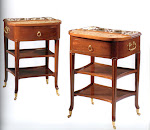
The usual rafraichissoir that developed around 1770, was most often apparently made by the Parisian ebeniste Canabas who seems to have made a specialty of them. You see a good example of the kind of rafraichissoir his workshop produced in the illustration of the pair below.


The lovely pair of rafraichissoir illustrated here were lot 813 at an auction at Christie's in New York on 20 October 2006.

Incidentally, as early as the 1770's these very useful tables were already customarily being made of mahogany before that wood really became so very fashionable on the eve of the French Revolution. In the engraving by Moreau le Jeune, entitled Le Souper Fin, you can see the very setting and social gathering at which it would have been put to (not surprisingly) very good use.


Understandably, as the curvaceous Louis XV style gave way to the more rectilinear Louis XVI and later Directoire Styles, the rafraichissoir similarly became more rectilinear as well. In the other illustration, you will note a restrained rafraichissoir of approximatly 1785-1790 that has enjoyed the benign fate of so many of these charming tables and is now used as a planter when not enlisted to service in a dining room. Incidentally, the lovely drawing room is in the Chateau de Chesnaie as illustrated in Meubles et Ensembles Époque Louis XVI by Yvonne Brunhammer and Monique de Fayet published in Paris by Éditions Charles Massin in 1965.